Who Made Significant Reforms such as Increasing the Roman Army to Strengthen Rome Again
The Roman Democracy was founded in 509 B.C.E. after the last Etruscan rex that ruled Rome was overthrown. Rome's next government served equally a representative commonwealth in the form of a republic. Initially, Rome's wealthiest families, the patricians, held power and just they could hold political or religious offices. Everyone else was considered plebeian, and no fellow member of this grouping could hold office. Over a period of well-nigh 200 years, however, the plebeians fought for and gained power within the government.
At the centre of the Roman Republic was the Senate. The Senate brash on matters pertaining to rules governing the city and population. In the commonwealth, members of the patrician class served equally advisers to the other governing bodies of the republic. Although the Senate did not formally make laws, the prestige of its members gave the Senate bully influence over Rome's law-making bodies.
The Senate lasted as a sole governing body for the republic for only a brief fourth dimension, lasting from the republic's founding in 509 B.C.E. until 494 B.C.E., when a strike orchestrated by the plebeians resulted in the establishment of the Concilium Plebis, or the Councilof the Plebs. This gave the plebeians a phonation in the authorities. Every bit a issue, new legislative, or police-making, bodies of the Roman Republic were formed. Called assemblies, these legislative bodies shared ability in the post-obit means:
- Comitia Centuriata— This body decided virtually state of war, passed laws, elected magistrates (consuls, praetors, and censors), considered appeals of uppercase convictions, and conducted foreign relations.
- Concilium Plebis— This body elected its own officials and formulated decrees for observance by the plebeian grade; in 287 B.C.Eastward., it gained the power to make all decrees binding for the entire Roman customs.
- Comitia Tributa— The tribal assemblies, open up to all citizens (who only could be complimentary, adult males), elected small officials, approved legislative decisions often on local matters, and could wield judicial powers simply could simply levy fines rather than administer penalisation.
Leading the republic were two consuls who were elected by legislative assemblies. They served for one year, presided over the Roman Senate, and commanded the Roman military. Though their power was somewhat express by the institution of other magistrate positions, the consuls were effectively the heads of country.
The republic stood stiff for several centuries. However, as Rome's power and territory expanded, internal conflicts began to emerge as citizens and families struggled for ability. For example, in the 1st century B.C.E., the famous Roman orator Marcus Cicero uncovered a plot by a Roman senator, Lucius Catiline, to overthrow the Roman authorities. Some citizens, such equally the Gracchus brothers, attempted to institute authorities reforms and social reforms to assist the poor. Ultimately, factions emerged (loyal to either the patrician or plebeian classes or to a specific military full general), hostilities erupted, and a serial of ceremonious wars plagued the republic. During these civil wars, a prominent general and statesmen named Julius Caesar began gaining pregnant ability. He commanded the loyalty of the soldiers in his regular army and enjoyed admission to substantial wealth afterwards conquering the province of Gaul.
The Senate, fearful of Caesar's power, demanded he surrender command of his army and return to Rome equally a denizen. Caesar refused, instead marching his ground forces south direct into Rome. As a result, another civil war erupted between Caesar and his chief political rival, Pompey. Caesar emerged victorious and was named dictator for life. Previously, the title dictator was given to an appointed, and temporary, leader in times of war machine emergency. Other leaders within the democracy feared Caesar would get a tyrant with this new championship. To preclude this, a group of senators conspired and assassinated him. In response to Caesar's death, his nephew and heir Augustus defeated the conspirators. He then established himself as the first Roman emperor.
The Roman Empire dramatically shifted ability away from representative democracy to centralized royal authority, with the emperor property the most power. For instance, under Augustus's reign, emperors gained the power to introduce and veto laws, as well every bit command the army. Furthermore, the emperor wielded significant authority over those who served in lower-level executive positions. No citizen could concord role without the emperor'south consent. Every bit a result of this redistribution of ability, the popular assemblies that functioned during the republican period became less important and lost ability.
While the associates became nearly formalism, the Senate survived. Primarily, the Senate survived during the early period of the empire equally a legitimizer of an emperor's dominion. The powers given to the emperor even so came from the Senate. Since the Senate was equanimous of Rome'due south elite and intellectual citizens, they impacted public stance. With this power, the Senate could declare an emperor to be an enemy of the state, or following an emperor'south removal or death, the Senate could officially wipe the tape of his reign from official history.
At the fourth dimension of Augustus's reign, the Roman Empire had solidified control over the Italian peninsula, established North African colonies following its victory over Carthage during the Punic Wars and controlled large swaths of territory in Spain and Gaul. Nether the emperors, Roman territory expanded farther, dominating most of the European continent, including Britain and major areas of mod-twenty-four hour period Eastern Europe.
This expansion, while bringing to Rome peachy wealth, power, and prestige, ultimately helped bring virtually its downfall. Fifty-fifty with the Roman road organisation contributing to the mobility of the military and trade, the cost of maintaining the vast empire weighed heavily on Rome'southward treasury and its political assistants. Added to this burden were increasing raids and attacks by strange tribes and communities. Emperors attempted to solve these problems through internal reforms.
For example, the emperor Diocletian carve up control of the Roman Empire into two halves, a western and an eastern portion. Diocletian believed the territories throughout the empire would be easier to control and support if they were overseen past 2 administrations. Future emperors attempted similar reforms, only ultimately internal conflict between the eastern and western halves, external pressure past foreign tribes, and the ongoing depletion of Rome's wealth and infrastructure finally rendered the empire vulnerable to plummet.
In C.East 476, the last of the western Roman emperors, Romulus Augustulus, was dethroned. Nevertheless, the eastern one-half of the Roman Empire, identified in history as the Byzantine Empire, would last another one thousand years until falling to the Ottoman Turks in C.East. 1453.
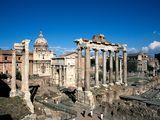
Though the Roman Democracy stood for several centuries, tensions inside the government began to tear it autonomously. Civil wars started between groups with different loyalties, which brought almost the transformation of the commonwealth into an empire. The Arch of Severus (middle) was added during the imperial phase of Rome, an add-on to a republican icon, the Roman Forum.
Photo past Peter Phipp/Travelshots.com
assassinate
Verb
to murder someone of political importance.
capital punishment
Substantive
death penalty.
censor
Verb
to ban, edit, or suppress material for political or social reasons.
ceremonial
Adjective
used for a ritual or formal occasion.
collapse
Verb
to autumn apart completely.
conquer
Verb
to overcome an enemy or obstruction.
consul
Noun
one of two chief officials of the ancient Roman republic who were elected every twelvemonth.
council
Noun
grouping of people selected to act in an advisory, administrative, or legislative capacity.
democracy
Noun
system of organization or government where the people decide policies or elect representatives to exercise and then.
dictator
Noun
person with complete control of a government.
emperor
Noun
ruler of an empire.
Etruscan
Adjective
(~768 BCE-264 BCE) people and culture native to Etruria, in what is now northern and central Italy.
executive
Noun
person with a high amount of potency and power in a company or business.
foreign
Adjective
having to do with another civilization, land, or nation.
formulate
Verb
to develop or create.
Gaul
Noun
Western European civilization that became a major office of ancient Rome.
government
Noun
organisation or guild of a nation, state, or other political unit.
head of state
Noun
public representative of a nation, sometimes the official leader of a country's government.
infrastructure
Substantive
structures and facilities necessary for the functioning of a society, such as roads.
Julius Caesar
Noun
(100 BCE-44 BCE) leader of ancient Rome.
Ottoman Empire
Noun
(1299-1923) empire based in Turkey and stretching throughout southern Europe, the Middle Due east, and Northward Africa.
overthrow
Verb
to forcibly remove from power.
patrician
Noun
a noble or person of high rank.
Noun
piece of land jutting into a body of water.
pertain
Verb
to be related or connected to something.
plebeian
Noun
mutual or low-ranking person.
political
Adjective
having to do with public policy, government, administration, or elected role.
prestige
Noun
positive reputation.
prominent
Adjective
important or continuing out.
Substantive
division of a state larger than a town or county.
religious
Adjective
having to exercise with spiritual belief.
representative
Noun
someone or something who acts in place of a group of people.
Roman
Describing word
having to practise with the civilization of ancient Rome, including the kingdom, republic, and empire.
Roman Empire
Noun
(27 BCE-476 CE) period in the history of ancient Rome when the state was ruled past an emperor.
significant
Adjective
of import or impressive.
sole
Describing word
only or individual.
strike
Noun
situation of people refusing to work in order to call attention to their working atmospheric condition.
swath
Substantive
path or line of material.
Noun
land an fauna, man, or government protects from intruders.
victorious
Describing word
having won.
vulnerable
Adjective
capable of being injure.
hastingswhournany.blogspot.com
Source: https://www.nationalgeographic.org/article/romes-transition-republic-empire/
0 Response to "Who Made Significant Reforms such as Increasing the Roman Army to Strengthen Rome Again"
Post a Comment